AI Regulation: Don’t Bet On It
By Matthew Lloyd (Director of Operations)
Reviewed and approved by James McKnight (Founder & CEO, Registered Portfolio Manager) — “The Prophet of Profit”

No one would have believed, in the last years of the nineteenth century, that this world was being watched keenly and closely by intelligences greater than man's and yet as mortal as his own. — The War of the Worlds, H.G. Wells
Power is like a drug: the need for either is unknown to anyone who has not tried them, but after the initiation the dependency and need for ever larger doses is born, as are the denial of reality and the return to childish dreams of omnipotence. — The Drowned and the Saved, Primo Levi
In June, the machines went dark.
Anthropic pulled two of its most powerful models and OpenAI locked its newest system, behind a wall that only government-approved customers could pass. The trigger was Mythos, a model that turned out to be unnervingly good at finding security holes in software, good enough that Washington worried it could hand hackers a skeleton key to everything. The White House signed an executive order giving itself up to thirty days to vet powerful new models before release. It looked like the reckoning had finally arrived.
Then, within weeks, the brake came off. Mythos returned. The Claude models came back. OpenAI reopened. The firmest act of AI oversight Washington had yet attempted lasted about as long as a hangover after a party.
We think this reversal tells you more about where AI is headed than the restrictions did, and that most people are reading it exactly backwards. The naive interpretation is that regulation is coming, that the state is finally flexing its muscles, that the doomers were right and the party is ending. Our view is the opposite. The June episode was not the beginning of restraint. It was a live demonstration of why restraint won't stick. And for investors trying to weigh the real risks to the AI trade, that distinction is worth a great deal.
How AI Regulation Talk Went From Fringe to Front Page
It is easy to forget how quickly the mood turns. Late in the Biden years, the safety crowd held the microphone. The 2023 executive order on artificial intelligence read like a document written by people bracing for catastrophe, all red-team reviews and national-security safeguards. A federal AI Safety Institute opened its doors. If you feared that AI might be throttled in the crib, that was the moment to brace for it.
Then the pendulum swung hard the other way. Within days of taking office in 2025, the Trump administration tore up the Biden order and replaced caution with a heavy foot on the accelerator. The summer brought an "AI Action Plan" built to clear obstacles, not erect them, and a push to stop individual states from writing their own rules. Regulation started to feel like an earlier relic, a fear we had all agreed to stop having.
So the story looked settled, until this spring it wasn't. The June restrictions dragged the subject back into the headlines. Politicians and business execs opined, and suddenly the question every investor thought was closed is open again: will governments, here or abroad, actually rein this technology in? That question won't be settled by the next headline. It was answered decades ago, by a very different arms race.
What the Bomb Can Teach AI Investors
For forty-five years, two superpowers held each other at gunpoint and answered the standoff by building more guns, tens of thousands more than either could ever use.
No Crops, No Cities, No Dividends: What Sixty Thousand Warheads Were For
At its peak in 1986, the two superpowers held more than sixty thousand nuclear warheads between them, out of a world total that neared seventy thousand. These were weapons with no productive purpose whatsoever. They grew no crops, powered no cities, and paid no dividends. Their only purpose was to leave no doubt that an attacker would perish alongside its victim, and leaving no doubt took a few hundred warheads, not sixty thousand. The rest was overkill, an arsenal built far past the point of any strategic logic, sustained by fear, bureaucracy, and the simple fact that the other side kept building too.
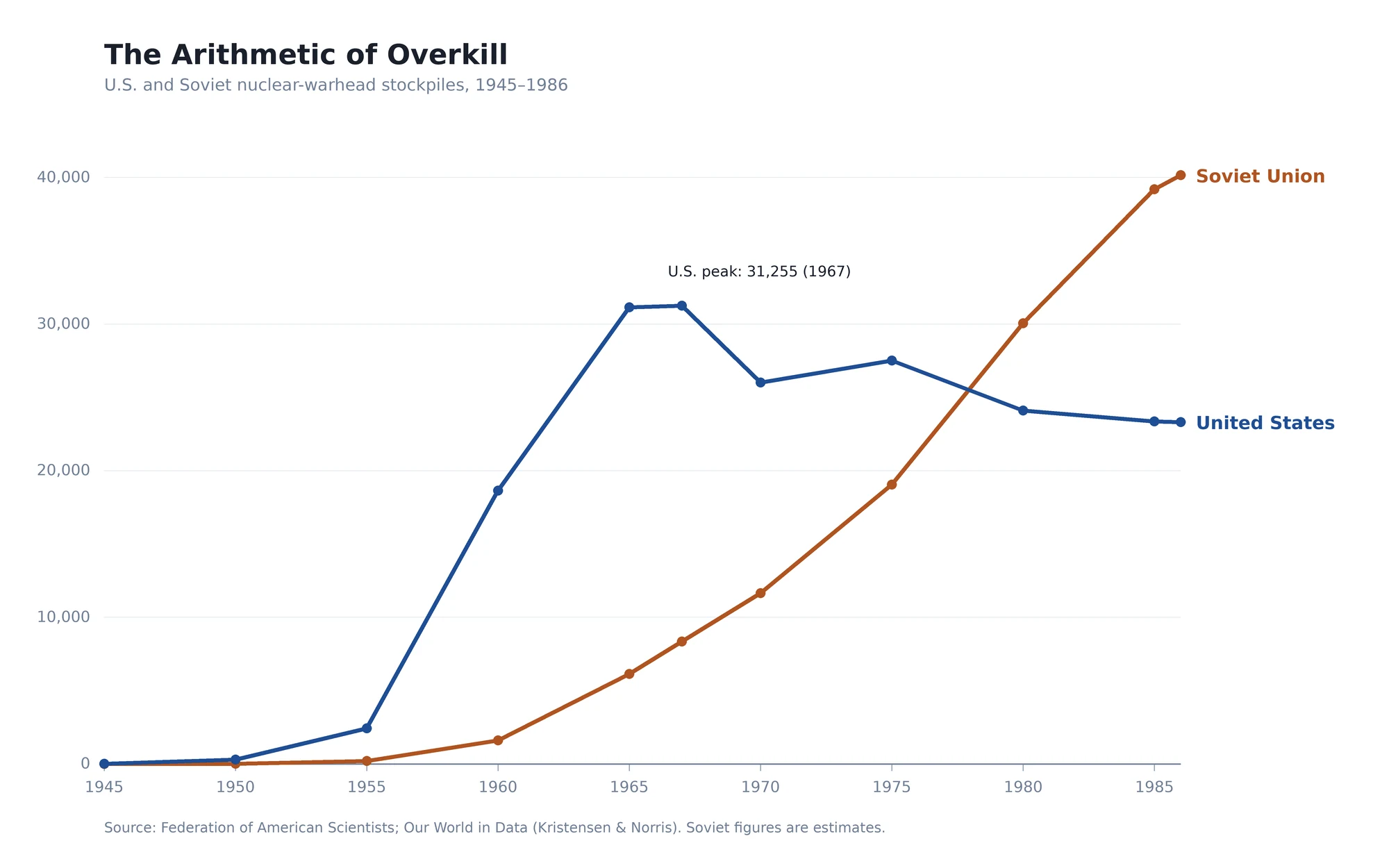
Source: U.S. Department of Energy / Federation of American Scientists, via Our World in Data
The Nuclear Arms Race Had a Ceiling. AI Does Not.
Economists have a name for the trap the two superpowers were in: the prisoner's dilemma. Each side would be safer if both showed restraint, yet each does better by building whatever the other does. Build while the other holds back, and you pull ahead; build while it does the same, and at least you have not fallen behind. So both keep building, year after year, and end up less safe than if neither had begun.
The nuclear version of that trap at least had a floor. Past a certain point, more warheads bought no additional safety, because you can only destroy a city once. Mutually assured destruction was, for all its horror, a kind of ceiling. Artificial intelligence has no such ceiling. More computation yields more capability, in warfare, in science, in every corner of economic life. There is no level of AI power at which a rational competitor decides it has enough. It behaves less like an arsenal you can cap than like an addiction, and the addiction, as Levi warned, only ever calls for a larger dose.
The Disarmament That Needed a Superpower's Collapse to Begin
Now, a fair critic will object that the superpowers did eventually cooperate, and they did. Treaties were signed. An entire class of missiles was eliminated. Arsenals fell by more than eighty percent from that mid-1980s peak, and today the world holds around twelve thousand warheads rather than seventy thousand. Adversaries who despised each other genuinely disarmed.
But look closely at the timing, because it is not the triumph it appears to be. The arsenal reached its all-time peak in 1986, after decades of arms-control talks had already come and gone. The treaties before then capped the growth without ever reversing it. The first agreement that actually cut strategic weapons was signed in 1991, a few months before the Soviet Union collapsed. The great disarmament, in other words, arrived only once one of the two rivals was collapsing. Cooperation did not tame the arms race at its height. It cleaned up the wreckage after one side had already lost.
And even that fragile peace is now unraveling. The last major treaty limiting American and Russian arsenals expired this February with nothing to replace it, leaving the two largest nuclear powers uncapped for the first time in half a century. None of this counts China, whose arsenal the Pentagon expects to pass a thousand operational warheads by 2030. Forty years and many treaties later, the arsenals remain large enough to destroy the world several times over. This was disarmament under about the friendliest conditions the world is likely to offer, and even so, the genie stubbornly refused to be coaxed back into its bottle.
Nuclear Material Needs a Reactor. AI Needs a Thumb Drive.
If mankind could not cooperate its way out of a potential nuclear holocaust, consider how much worse the conditions are for AI, and how much less likely is cooperation.
Nuclear weapons have no economic value, which makes giving them up a matter of pure survival calculus. AI is valuable everywhere, in every business process and battlefield and laboratory, which means every actor has a powerful incentive to keep pushing. Nuclear material is physically detectable, made in enormous facilities you can photograph from orbit, and monitored by international inspectors. A dangerous AI model is a file. It can be copied in seconds and carried across a border on a device the size of a thumbnail. You cannot email plutonium. You can email a model.
The nuclear race had two serious players. The AI race has the whole world: the United States, China, and behind them Russia, Israel, India, the Gulf states, and any nation with the wealth to buy chips or the talent to write code. Now ask yourself the practical question. Suppose Washington and Beijing somehow agreed tomorrow to slow down, a proposition that would take something close to a Skynet-scale disaster to imagine. What about everyone else? All it takes is one country pushing one boundary in pursuit of some real or imagined edge, and the rest slam the accelerator in response. The accelerationists win, not because racing is wise, but because being lapped is intolerable.
Your Portfolio Already Owns the AI Trade. The Question Is How Much.
Start with why this matters to your portfolio and not just to Silicon Valley. The largest companies on the planet are, one way or another, artificial-intelligence companies. Nvidia, Microsoft, Apple, Alphabet, Amazon, and Taiwan Semiconductor sit at the top of the market, and each has staked a large share of its future on the AI buildout. Even SpaceX belongs on the list now, after a record-breaking public debut in June that vaulted it into the ranks of the most valuable companies in the country. And here you were thinking this was a rocket company with a satellite-internet side hustle. Look at how its own backers carve up the opportunity in front of it.
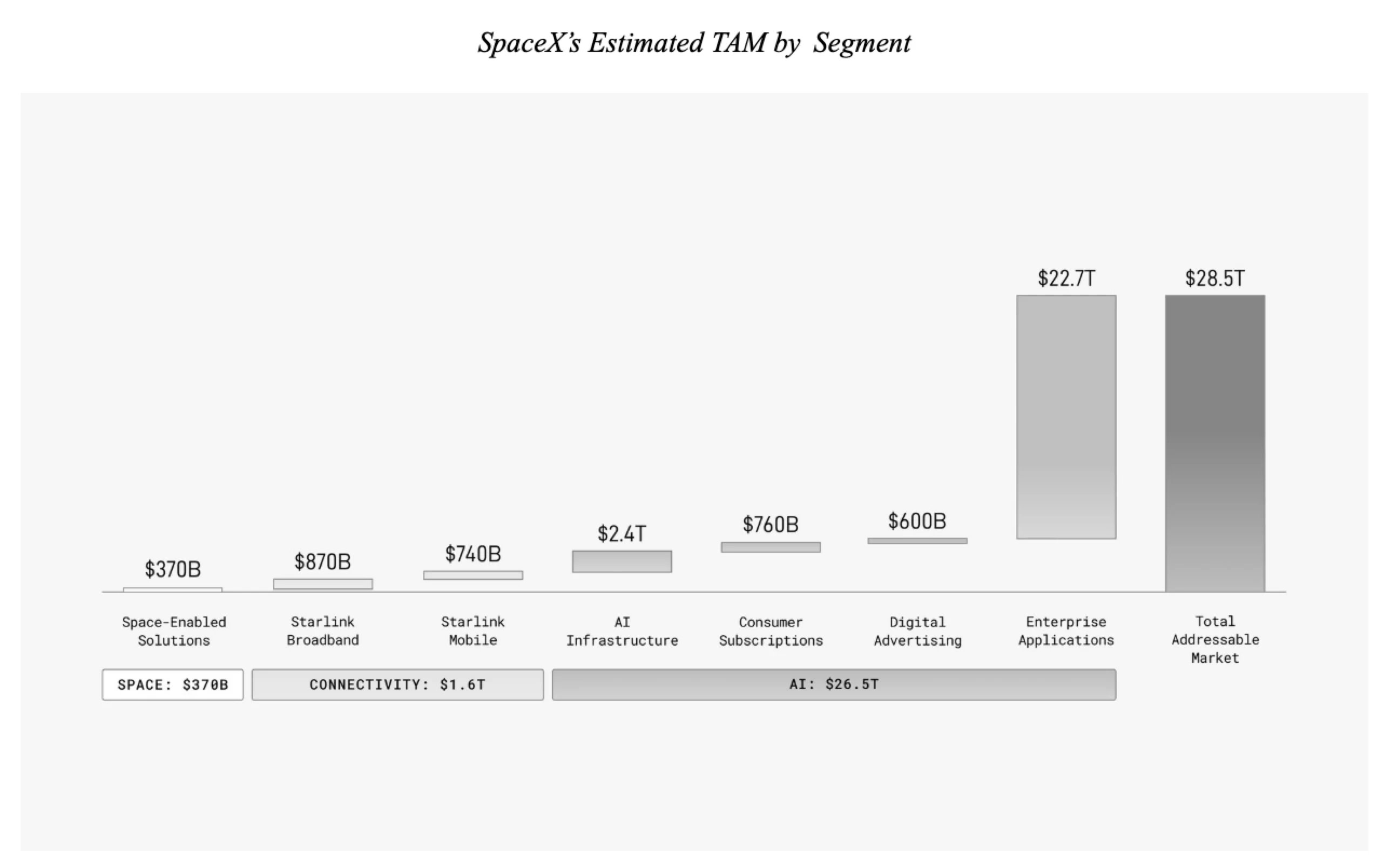
Source: SpaceX S-1 filing
The reach runs deeper than the obvious names. Consider Caterpillar and Cummins, two firms your average reader would never file under "technology." They make big, loud, yellow things: engines and heavy machinery. They are also posting the most dramatic share-price appreciation in their long histories, because every data center in the world needs backup power, and backup power is exactly what they sell. When the market bids up the makers of industrial generators as if they were chip designers, it is telling you how little doubt investors have about where the spending is headed.
The numbers are hard to hold in your head. The biggest technology firms are on course to spend north of seven hundred billion dollars on AI infrastructure this year alone, and the data centers they are racing to build will roughly double their draw on the world's electricity by the end of the decade. This is not hype waiting to deflate. It is the largest infrastructure program of our lifetimes, and it runs straight through your retirement account. If regulation could choke the buildout, it would choke your portfolio with it.
The Worst Sales Pitch in Technology: How AI Earned Its Enemies
Here is the part our thesis has to survive, because the case for regulation is not weak. The public has turned on AI, and it has turned hard. The share of Americans who feel more worried than excited about it has climbed from roughly a third at the start of the decade to about half today. The sourest group of all is independents, the swing voters both parties chase every November.
A Gallup survey this spring put a number on it. Asked what they would tolerate as a neighbor, Americans opposed a new data center more strongly than a new nuclear power plant, seventy-one percent against fifty-three. Sit with that. People would rather live beside a Chernobyl-to-be than beside a server farm. The industry came by this reputation honestly, having spent years telling the public that its product would first take their jobs and then, possibly, their lives. As economist Noah Smith points out, no one has ever sold a product this badly. Politicians have noticed. Talk of nationalizing the labs, unthinkable not long ago, now comes from both the socialist left and the populist right.
So the political will to punish this industry plainly exists. The pressure is real, bipartisan, and growing. Why, then, are we so confident it won't amount to a brake that actually holds? Because the world has already tried to hold back a dangerous technology once before, under conditions far friendlier to success than anything AI offers, and it still built enough warheads to end civilization many times over.
The Firmest Act of AI Oversight Lasted About as Long as a Summer Cold
Which brings us back to June, and to the models that went dark and then came roaring back.
That episode was about as clean a test of regulation as we are likely to see. The threat was concrete and frightening, a genuine national-security risk rather than an abstract worry about some distant future. The administration was willing to act, and it did, pulling real products from real companies. Then the pause held for a matter of weeks before the pressure to compete, to ship, and above all not to fall behind China overwhelmed it. Future models may well prove more dangerous, and we would be surprised if they didn't. But the same forces that reopened these ones will still be pressing just as hard. When restraint collapses this quickly with a real danger and a willing public behind it, restraint is not a force you should build an investment thesis around. The brake exists. It simply cannot hold against the engine.
The AI Trade Has Real Risks. Regulation Isn't the One to Lose Sleep Over.
We are investment advisors, not philosophers, and we want to be clear about what we are and are not saying. We are not claiming that an unchecked AI arms race is wise, or desirable. We are saying that this is the future we are likely to get, and that clear-eyed people should plan for the world as it is rather than as they wish it to be. If humanity is driving toward a cliff, history suggests we will do it with the pedal to the floor.
So when you weigh the genuine risks to the AI trade, and there are many, rank them honestly. Sky-high valuations are a real risk. Brutal competition is a real risk. The ordinary violence of a boom in a transformative technology is a real risk, and the history of railroads, radio, and the internet is a history of world-changing inventions that still ruined plenty of investors along the way. Government regulation throttling the industry's growth, however, sits near the bottom of that list. Not at zero. But not the risk that should keep you up at night, either.
In the meantime, a general-purpose technology on the order of electricity and the internet is being built out in real time, in front of us, at a scale with few precedents. For the long-term investor, that is not a reason to bury the gold bars in the backyard and wait for the storm. It is the defining opportunity of the era, risks and all. The prophets of doom may yet be proven right about where all this ends. But doom has long sold better than it forecasts, and we would rather own the future than short it.