The Most Expensive Investing Call You'll Ever Make
By Matthew Lloyd (Director of Operations)
Reviewed and approved by James McKnight (Founder & CEO, Registered Portfolio Manager) — “The Prophet of Profit”

I am large, I contain multitudes
— Song of Myself, Walt Whitman
"How did you go bankrupt?" Bill asked. "Two ways," Mike said. "Gradually and then suddenly."
— The Sun Also Rises, Ernest Hemingway
Poor Investment Decision Making Can Haunt You in Retirement" work?
When it comes to investment decision making, selling at the bottom is arguably the worst mistake an investor can make. Not picking the wrong stock. Not chasing a hot sector. Not starting too late. Those can be fixed. Selling at the bottom is different. First you lock in the loss. Then you watch the recovery happen without you.
We know this because we watched it happen.
In 2009, James McKnight—then an investment manager at another firm—was working through the ugliest market many investors had ever seen. The S&P 500 had fallen roughly 57% from its highs. Every account was down. Every headline was dark. The word "unprecedented" was getting a workout.A client called. They weren't sleeping. The stress had become unbearable, and they wanted out of everything. James walked them through the history: bear markets are brutal, but they end. They always have. Selling now risked turning a temporary paper loss into a life-altering event.
They listened. Then they sold anyway.
They came back later, ready to get back in. By then, the market had already done what markets so often do after a panic: recover. They sold low, bought back high, and the distance between those two prices became a permanent feature of their retirement plans.
Sell Low. Wait Longer. Buy Higher.
Investors do not usually sell because they have done some calm, rational reassessment of long-term value. They sell because the market reeks of fear, and they can’t stand the smell. And the fear that drives investors to sell doesn't disappear once they're out. It follows them.
After a panic, investors tell themselves they are waiting for clarity—for the headlines to calm down, for some sign that the worst is definitively over. But markets don't ring a bell at the bottom, and certainty is as scarce as a financial forecast that ages well. So they wait a little longer. Then a little longer still. And while they're waiting for permission to feel safe, the market moves on.
That is the irony. The same fear that pushes an investor out often bars the door on the way back in. By the time confidence returns, so have higher prices.
The Odds Get Worse. The Case for Staying Invested Gets Better.
Here's what few advisors tell you at the start of your investing journey: bear markets are not rare catastrophes visited upon unlucky investors. They are a predictable feature of long-term investing. The only real questions are how bad, how long, and whether you'll be ready.
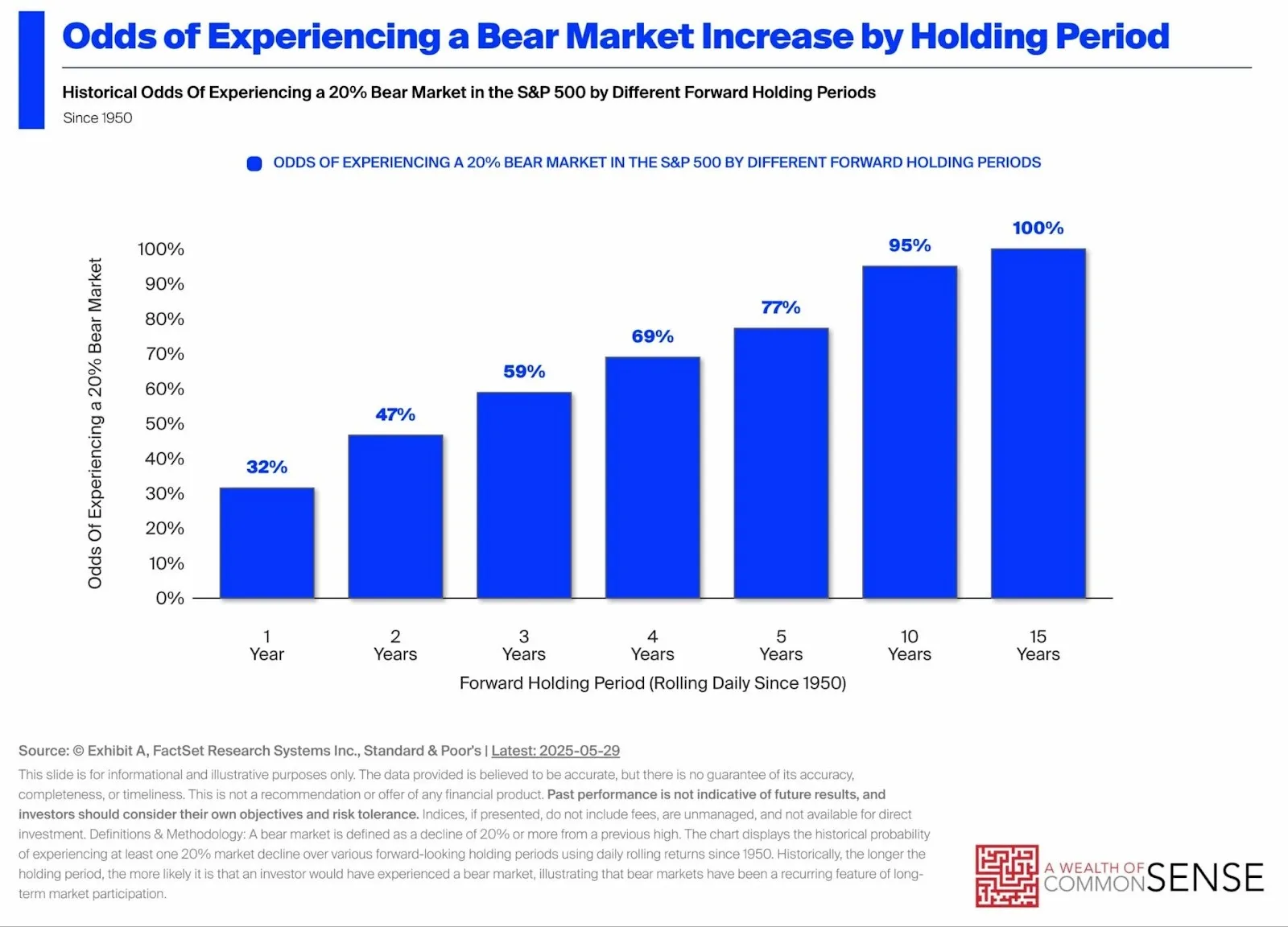
Source: A Wealth of Common Sense
Since 1950, the odds of living through a 20% market decline grow with every year you stay invested: 32% over one year, 77% over five, 95% over ten. Hold for fifteen years and the probability reaches 100%. Not 'likely.' Not 'probable.' Certain.
The right response to that fact isn't to invest less. It's to stop being surprised by it.
Risk Tolerance Meets the Real World
Walt Whitman said he contained multitudes. So does every investor: the patient one with a plan, and the one who calls their investment advisor at 2 a.m.
Risk capacity is your financial ability to absorb a market decline without derailing your goals: your time horizon, your cash reserves, your income stability. Risk tolerance is something else entirely. It is your emotional ability to watch your account fall, month after month, headline after headline, without handing the wheel to your worst instincts.
Capacity without tolerance is a car with a full tank and no steering wheel.
Sound portfolio management starts with a Know-Your-Client (KYC) process that measures all of this: how long you can stay invested, how you'd respond to a significant decline, what volatility has felt like in the past. These are reasonable questions, central to any serious wealth management process. But they're often asked under bright lights, becalmed markets, and hope for the future.
The trouble with statistics is that they happen to other people. The story of someone who couldn't sleep, made the call, and paid for it for the rest of their investing life stops being abstract. It happens to you. It happens to you.That's why, at Wealth Preservation Management, we share this story with new clients. Not because the KYC questions don't matter (they do) but because a real person, a real phone call, and a permanent consequence land harder than option C on a form.
Bears Get the Headlines. Bulls Get the Last Word.
Now the good news—and there's plenty of it.
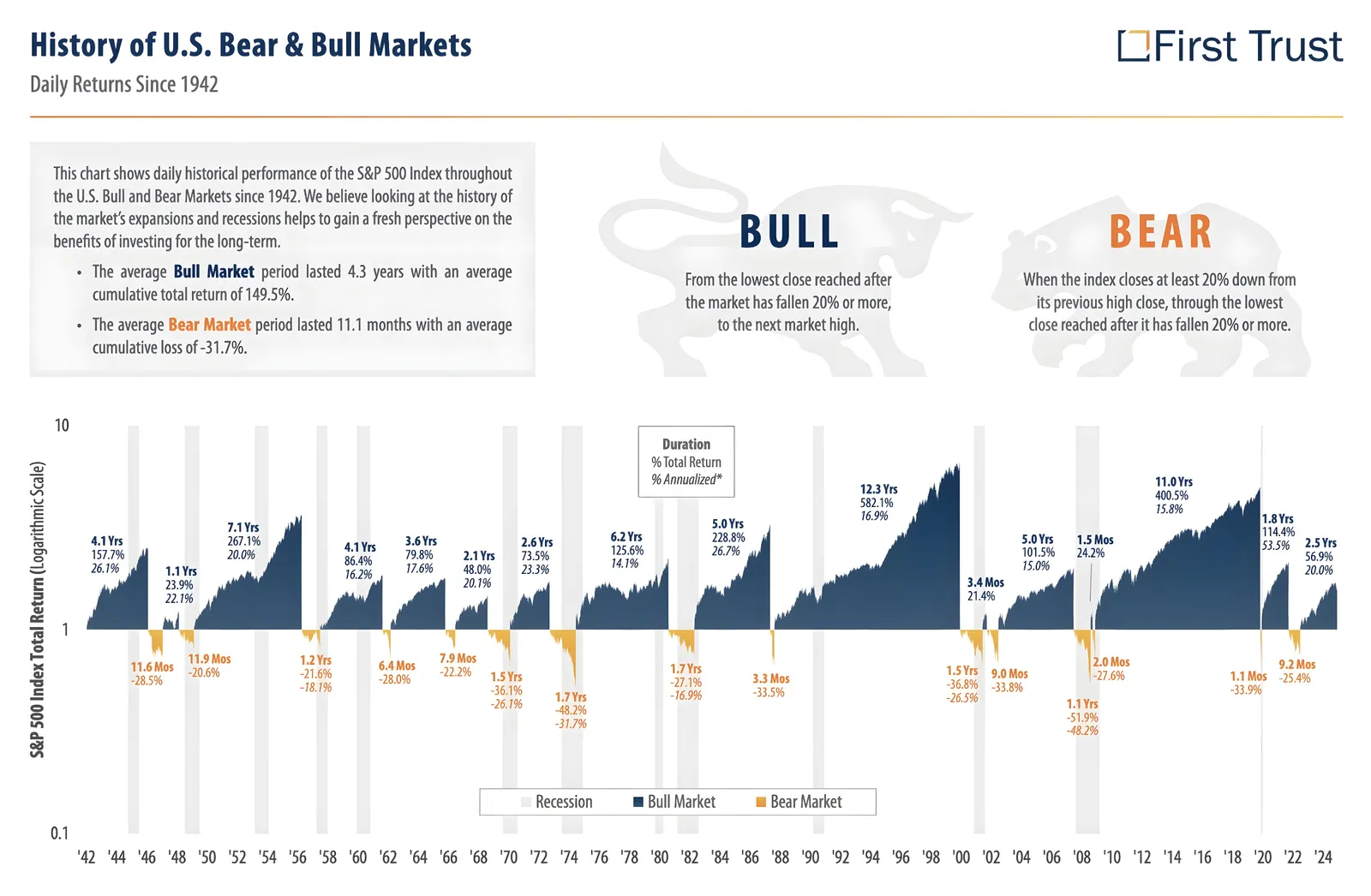
Source: First Trust
Since 1942, the typical U.S. bear market has lasted less than a year and cut equity values by 31.7%. It hurts. But consider what follows: an average bull market lasting 4.3 years, delivering 149.5% in cumulative returns. The market doesn’t punish patience; it tests it.
Look at the chart: short, sharp drops in orange, followed by massive dark mountains. Every single bear market was eventually swallowed by a bull.
The client who called James in 2009 sold near the bottom of one of those orange bars. What came next was one of the longest bull markets in history. The gains were real. They just didn't belong to them anymore.
The Right Portfolio Manager Prepares You for the Wrong Market.
Preparation isn't about courage or perfect calm. It's about meeting the bear market in your mind before it comes for your account.
At Wealth Preservation Management, we build portfolios for the long term. That means building investors for it too.
Another bear market is coming. The charts say so. History says so. The only question is whether you'll be ready.
If you'd like to work with a Portfolio Manager who builds for both your financial goals and your real risk tolerance, contact us today.