Feeding the Beast: Why Corporate Giants Keep Growing
By Matthew Lloyd (Director of Operations)
Reviewed and approved by James McKnight (Founder & CEO, Registered Portfolio Manager) — “The Prophet of Profit”

It was a monster devouring with a thousand mouths, trampling with a thousand hoofs; it was the Great Butcher---it was the spirit of Capitalism made flesh. Upon the ocean of commerce it sailed as a pirate ship; it had hoisted the black flag and declared war upon civilization.
— Upton Sinclair, The Jungle
Appetite comes with eating.
— François Rabelais, Gargantua
Move Over GDP: Leviathan Awakens
Corporate consolidation used to terrify us. Monopolies were monsters to be slain, not business models to be embraced. Now we watch placidly as tech giants outgrow entire nations. As of Aug 28, 2025, Nvidia's $4.4 trillion market cap exceeds the GDP of all but three countries:
- U.S. – $29.18 trillion
- China – $18.74 trillion
- Germany – $4.66 trillion
For investors, the trillion-dollar question is simple but crucial: will these corporate behemoths keep growing? Understanding the forces driving their expansion may be the difference between exceptional returns and market mediocrity.
The Invisible Architecture of Capitalism
Between Anarchy and Empire: The Firm
In 1937, economist Ronald Coase asked a deceptively simple question: why do companies exist at all? Why not just let individuals transact freely in an open market? His answer reframed how we think about economic organization—firms exist to reduce transaction costs: the hidden toll of figuring out what to do, who should do it, and how much to pay for every single thing.
Picture trying to run Microsoft without Microsoft. Each morning, you'd need to hire 180,000 people, secure office space across 120 countries, and negotiate millions of individual contracts. By noon, you'd have accomplished nothing except developing a profound appreciation for human resources departments.
The World Shrunk—and Profits Soared
This insight revealed something profound: the natural size of a company is limited by its internal transaction costs. Five centuries ago, coordinating thousands of knowledge workers across continents was impossible—messages took months to cross oceans, if they arrived at all. The East India Company needed three years to get a reply from its Asian operations. Today, that same message is instantaneous and essentially free:
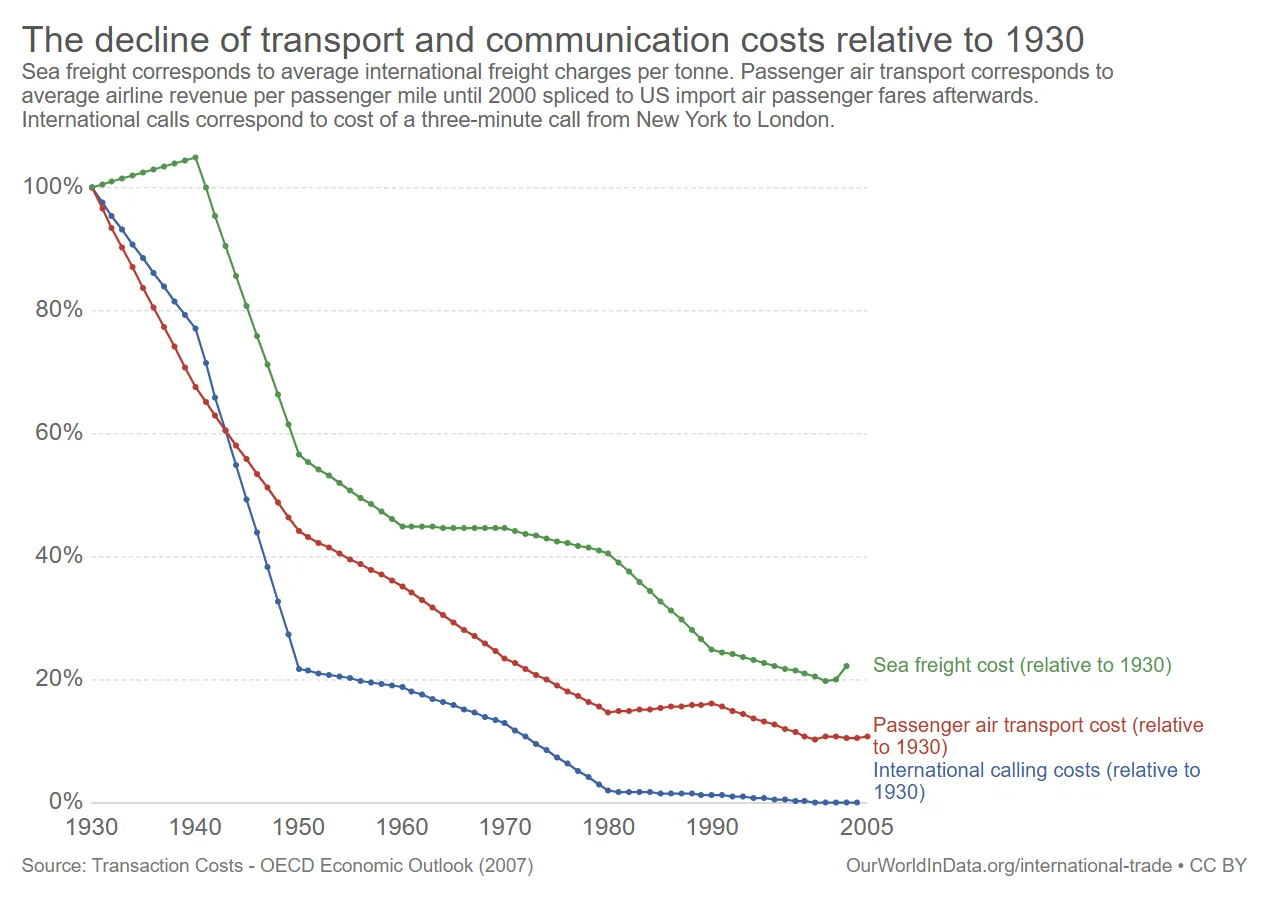
Source: Our World in Data
From Steel and Smoke to Silicon and Cloud
The numbers are stark. In 1990, when computing power was still measured in megahertz, the top five S&P 500 companies held 12.2% of market capitalization:
IBM – 2.9%
- Exxon Mobil – 2.9%
- General Electric – 2.3%
- Philip Morris – 2.2%
- Royal Dutch Shell – 1.9%
As of Aug 28, 2025, they command 27.42%:
Nvidia – 7.55%
- Microsoft – 6.49%
- Apple – 5.92%
- Amazon – 4.23%
- Meta – 3.23%
Notice how the apex predator of capitalism has changed? Technology companies have overtaken industrials, consumer goods, and oil as the dominant force.
When Bigger Also Means Better
And size isn’t the only story here—profitability is pulling away too. In the 1990s, large companies out-earned smaller ones by about 15% on their operating assets. Now, that gap is 30–35%. That’s not a small edge—it’s a chasm.
From Stopwatch to Superintelligence
Traditional corporate growth has always faced natural limits. Expansion increases complexity, new layers of management add friction, and decision-making slows to a bureaucratic crawl. These were the corporate laws of nature that survived every management revolution since Frederick Taylor first fetishized the stopwatch.
Enter artificial intelligence. However the future unfolds, the speed of adoption is astonishing. The telephone took 75 years to reach 100 million users. Email? Seven. ChatGPT? Two months.
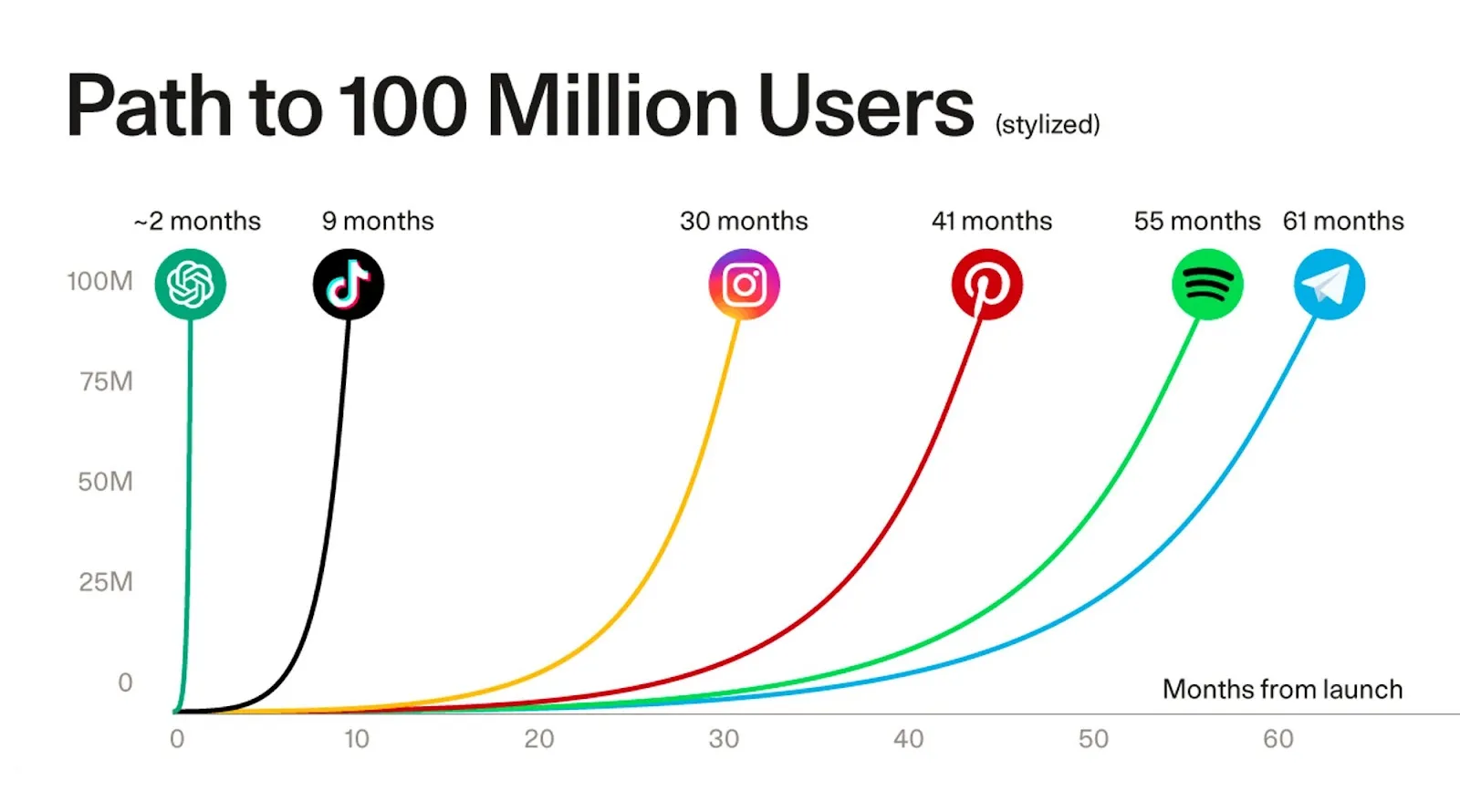
Source: Sequoia Capital
And we’ve barely entered the first inning of AI’s development. If AI were a videogame, we’d be playing Pong right about now.

Source: Gemini
AI Didn’t Replace Us. It Just Made Us Better.
Estimates of AI productivity gains vary. The St. Louis Fed comes in low, at 5.4%. Norway’s sovereign wealth fund puts the number near 20%.
At Wealth Preservation Management, our day-to-day experience backs the higher-end estimates. We’ve gone from mild skepticism to using AI across much of the business. It doesn’t just save time—it raises the quality of our work in ways that weren’t possible before. Losing it now would feel like losing Google a few years ago.
The Ghost in the Growth Engine
The productivity gains we’re seeing from AI early adopters are just the opening chapter of a much longer story. The headline numbers are impressive, but they mask a deeper shift: big companies aren’t just getting more efficient—they’re building self-reinforcing growth engines. Every customer interaction, every transaction, every process tweak can train their AI, making them incrementally better at serving the next customer.
Investing in the Shadow of Giants
Smaller companies will have access to powerful AI tools, but many will be nibbling at the edges while larger firms reshape entire operations. According to the Future of Jobs Report 2025, just 29% of small and mid-sized enterprises have adopted AI tools, compared to 70% of large companies. SMEs are also 40% more likely to lack AI-ready talent. And when it comes to investment, bigness has a beauty all its own:
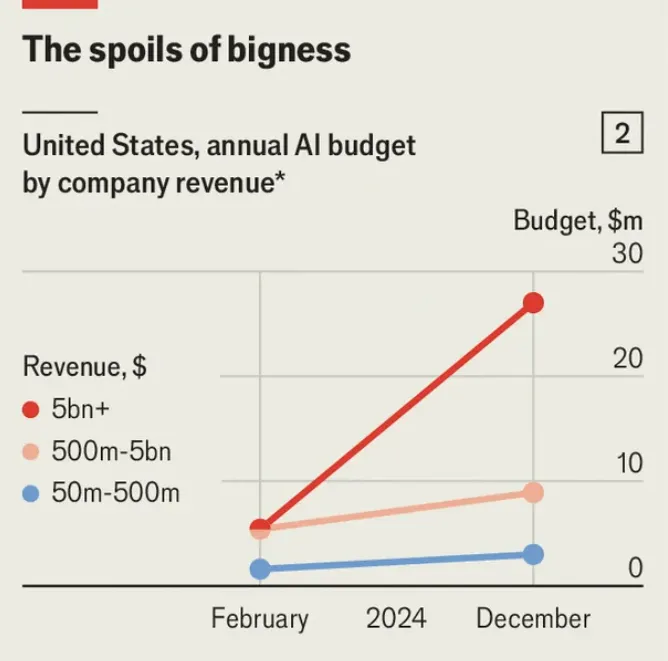
Source: The Economist
Firms that learn to leverage the AI feedback loop have the opportunity to unlock growth that eclipses even the most celebrated success stories of the past. And investors who buy into technological laggards because they seem “reasonably priced” risk seeing their returns shrivel.
Bigger, Faster, Smarter—And More Investable
Technology reduces friction, consolidating corporate power and spurring global growth—and AI stands to accelerate that longstanding trend. Like a gourmand whose appetite increases with the eating, companies that master AI are poised to devour their competition.

Source: Gustave Doré
Pearls Are for Clutching. We’ll Take the Returns.
Critics can clutch their pearls and decry monopolistic practices, but their wailing won’t grow your wealth. While others wring their hands, at Wealth Preservation Management we’re positioning client portfolios for the market as it is—and as it’s becoming.
Dismiss it, fear it, or figure it out. Either way, in a world built for scale, betting against bigness is a mistake. Let’s grow together. Contact us today.