Profit and Prose: Investing Lessons from the Greats
By Matthew Lloyd (Director of Operations)
Reviewed and approved by James McKnight (Founder & CEO, Registered Portfolio Manager) — “The Prophet of Profit”

Professional money managers are losing—badly. 95.51% of Canadian equity fund managers can't beat the market over a 10-year period. So why not seek wisdom from minds who've outperformed their peers for centuries?1
Great authors may not be fluent in fundamental analysis, but they understand the human comedy driving markets. While Wall Street's finest keep discovering exciting new ways to underperform, consider the brilliant minds who've never charged management fees for their insights into greed, fear, and self-delusion.
1SPIVA data is for industry context only and not a direct comparison to WPM’s strategy or results.
Rebalancing: What Adults Do With Their Gains
“As the swift monster drags you deeper and deeper into the frantic shoal, you bid adieu to circumspect life and only exist in a delirious throb.”
— Herman Melville, Moby Dick
As stock prices rise, IQs tend to drop. Investors fall in love with their winners, frozen by success—but markets have a way of harpooning overconfidence.
Consider our modern-day Ahab: a British Columbia carpenter who turned $88,000 in Tesla options into $415 million, only to watch it evaporate when the price dropped and he got a whaleish margin call. Now he's suing RBC, for not saving him from himself.
This is an extreme example of why professionals set target portfolio weights and systematically rebalance, taking their winnings off the table, maintaining discipline when everyone else is being dragged into the frantic shoal and the delirious throb.
Overinformed and Underperforming: Why You’re Losing to the S&P 500
“Don't question your conscience so much—it will get out of tune, like a strummed piano. Keep it for great occasions.”
— Henry James, The Portrait of a LadyToday's investors have more data than NASA's mission control, yet the vast majority still underperform the S&P 500. Why? Because they're constantly strumming that piano, transforming solid investments into a symphony of second-guesses.
Consider that the average holding period for stocks has dropped from 5 years in the 1970s to just 10 months in 2024.
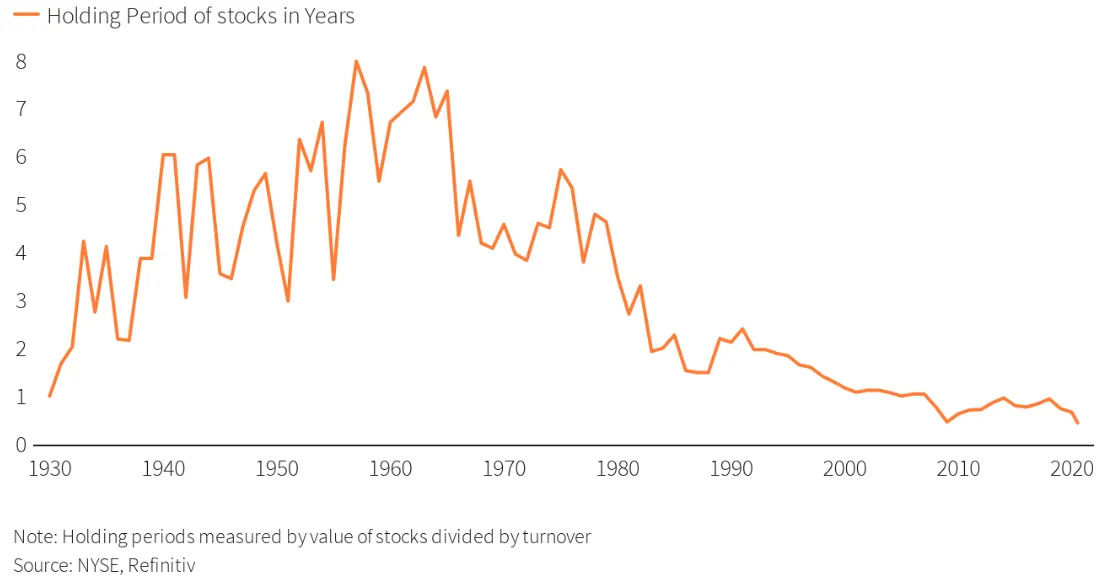
Source: eB
We've gone from "buy and hold" to “not so much,” where a cacophony of data drowns out any hope of insight or wisdom. Unsurprisingly, average investors are suffering:
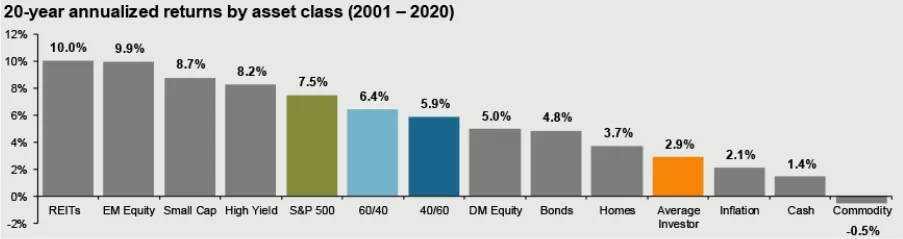
Source: TradeThatSwing
KISS (Keep It Simple, Stockholder)
“Wouldn't it be better to stay peacefully in your house and not wander around the world searching for bread made from something better than wheat?”
— Miguel De Cervantes, Don Quixote
Don Quixote chased windmills; today’s economic knight-errants have more exotic taste. Consider this:
- 95% of non-fungible tokens (NFTs) are now worthless (is anyone actually surprised?)
- 85% of SPACs that completed reverse mergers in 2022 are trading below their IPO price
- Etc., etc., etc.
You know what still works? Buying and holding great companies with proven track records, great management, and operating models you actually understand. Crazy, right?
Value Investors: Finance’s Hopeless Romantics
“Only the poet or the saint can water an asphalt pavement in the confident anticipation that lilies will reward his labour.”
— Somerset Maugham, The Moon and Sixpence
Value investors are the hopeless romantics of finance—finding beauty and meaning in P/E ratios where others see only decline. Their religious faith in the magic of “mean reversion” is useful when you need someone to take the other side of a trade, but bargain hunting in business graveyards is sub-optimal, and rarely ends well.
Consider buying:
- Kodak, because it was "undervalued”—failing to notice a little thing called digital photography.
- Blockbuster, because it generated cash and screened well on value metrics—if you ignored the whole "Netflix" thing.
Of course, you need to read a company’s financials—but don’t forget: those numbers face backward, and time’s arrow flies fast forward. This is why the windshield is larger than the rear-view mirror. Neither a poet nor a saint be.
Mediocrity Is Not a Retirement Strategy
FOOL
If thou wert my fool, nuncle, I’d have thee beaten for being old before thy time.KING LEAR
How’s that?FOOL
Thou shouldst not have been old before thou hadst been wise.
— Shakespeare, King Lear
Five centuries before CNBC, a court jester was delivering hard-hitting investment advice. Lear didn’t listen–but we hope you will. Don't wait until you are sharing his retirement accommodations: a hovel on the heath. Smarten up and start demanding more from your money.
The brutal math:
- A 7% annual return doubles in 10 years, whereas a 20% return doubles in 3.5 years.
Don’t humor your plodding advisor’s subpar returns—it’s not good enough. Retire like a king or live like Lear; the choice is yours.
Your Portfolio Deserves a Better Story
At Wealth Preservation Management, we believe minds, like investments, compound in value when properly nourished. Read the classics; beat the index.
If you share our enthusiasm for literary and financial growth, let's talk. Our reading list is on the house.
Ka-ching, the check is in the mail.