Confessions of a Reformed Investment Advisor
By Matthew Lloyd (Director of Operations)
Reviewed and approved by James McKnight (Founder & CEO, Registered Portfolio Manager) — “The Prophet of Profit”

Hello all, my name is Jim McKnight and I am the Founder and CEO of Wealth Preservation Management (WPM). I’m in the business of growing my clients’ wealth, but I’ve found that people usually like to know a bit about me before handing over their wallet, so here we go…
From Eccentric Nerd to Financial Professional
It’s taken me years to embrace it, but at heart I’m an eccentric nerd (big fan of sci-fi). I first realized I was a bit of an outlier as a young boy. In class I had an uncanny knack for coming up with intuitive answers based on a logic I couldn’t easily trace from A to B to C. I was more of an A-to-C guy, which often made me seem rather odd. For years I lacked the confidence to trust my “gut”; after all, I put my pants on one leg at a time—what do I know anyway? But the niggling suspicion that I could make use of my intuitive gifts never left me. This, combined with a love of markets, led me to finance.
What’s Wrong with Traditional Portfolio Management?
My first experience as an advisor was with a large firm, during which time I studied hard and worked long hours for little reward and much frustration. I hoped to unlock the secrets of successful investing by observing “how things are done” by the professionals. Imagine my consternation when I failed to consistently deliver respectable returns for my clients! Struggle as I might, the traditional, conventional practices of portfolio management were not working. Why?:
- most practices have more than 100 clients
- most clients have more than 4 accounts
- most accounts hold more than 30 securities (usually many more)
- now do the math: 100 x 4 x 30 = 12,000 lines in Dataphile (the industry standard software we use to manage client accounts)
- so, your standard Investment Advisor is responsible for over 12,000 Dataphile entries (securities, prices, portfolio weights, etc) … what a mess!
Why Diversification Fails Most Investors
Upon realizing this, I immediately began to wonder how my colleagues were achieving good results for their clients. Who could possibly have the mental bandwidth to remember what they own, why they purchased it at that price, and stay on top of every security in all their client accounts? Analyzing hundreds of earnings reports would be a full-time job itself, and if you aren’t paying close attention to each company then how can you be effective?
When I finally worked up the courage to start asking my peers about their returns, it turned out they were equally disappointing! Could this possibly be the industry standard? Who can afford to retire in comfort and dignity with these meagre returns? Why do investors put up with it?
From Frustration to First Principles
I finally decided to trust my gut and rebuild everything from the ground up. First, I had to simplify my practice and dramatically improve my investment techniques. To accomplish this, I became a Portfolio Manager (PM) (as opposed to an Investment Advisor who treats each account separately and needs client approval for every trade). Being a PM allows me to run a Model Portfolio that all my clients enrol in which means is that everyone buys/sells the same stocks, at the same time, at the same price. This allows me to treat every client like they’re my only client, because each decision I make affects all my clients.
Cool, except that a worthwhile Model Portfolio must be able to beat the relevant index (say the S&P 500) plus fees (WPM charges 2%). That means I had to exceed 10%/yr. in returns, and I still wasn’t there. Cue the frustration, long hours, and reading everything I could lay my hands on to improve my performance. Orwell once said that perhaps a lunatic is simply a minority of one. I never doubted my sanity, but I realized that it would be crazy to do the same things that weren’t working over and over. So, I tinkered, I experimented, I challenged myself, I trusted my gut, and gradually (ever so gradually) my results started to rise.
I eventually raised my returns into the mid-teens, which was still too modest (I want to make my clients rich). I kept asking myself: “What would a Model Portfolio look like if it defied conventional wisdom?”’
The Secret Sauce: Simplicity, Focus, and Returns
Many ideas didn’t work, but patience and stubbornness paid off; so, gather round while I reveal the secret sauce:
- When advisors have hundreds of different securities in their client accounts, they can’t possibly follow each company closely, and it makes sense to hold lots of different securities in each client account (or even better ETFs!), because if you diversify enough, you will roughly track the index, and who ever got fired for being a closet indexer?
- I would be ashamed to track an index, and if I can’t beat the index then why would anyone trust me with their money?
The Case for Focused Investing
- I run what is called an equal weighted 14-security portfolio (14 securities @ 7% each), which prevents you from over-diversifying (“diworsifying”) and forces you to focus on only the best ideas. It also requires you to drop underperformers because they can have a large effect on your returns. For investors seeking wealth accumulation (and with appropriate investment objectives, risk profile, time horizon, and personal circumstances) judicious concentration is your friend, and overdiversification a tax on the timid or unwise.
- So all you need to do is find really great stocks to own: how do you do that?
How I Screen for the Best Stocks
- First, follow the numbers: the stock market might get things wrong in the short term, but invariably gets them right in the longer term. To find the best stocks, start with a list of new ‘All time high’ stocks. Download the S&P 500 constituents to your market screens, and sort them by performance (YTD, 1 Yr, 3 Yr, 5 Yr, 10 Yr). What you will notice is that stocks that tend to outperform over one timeframe also outperform over multiple time frames. This makes intuitive sense, since great businesses with excellent management are rewarded over time, while dogs are punished.
- So, we have identified the S&P 500’s top performers (let’s say the top 10% by historical performance: 50 companies). Now we’re getting close to something manageable for closer analysis.
From Good to Great: Narrowing the Field
- But this is where things get tricky and judgement is called for: you need to sort these winners to identify the best of the best. Which stocks have the strongest operating model, which have the best growth model? Which stocks did well in the past but have dimming prospects, and which have the best long-term outlook?
- Research each company exhaustively and choose 14 according to your best ability. You will make mistakes, you must constantly monitor your Model Portfolio, and you will need to make changes. However, what you should see fairly quickly is that your returns consistently increase.
Thus, what WPM does is not arbitrary or inconsistent: we have a repeatable system, an investment engine, and it works.
Our Portfolio Returns vs. the Competition: How We Stack Up
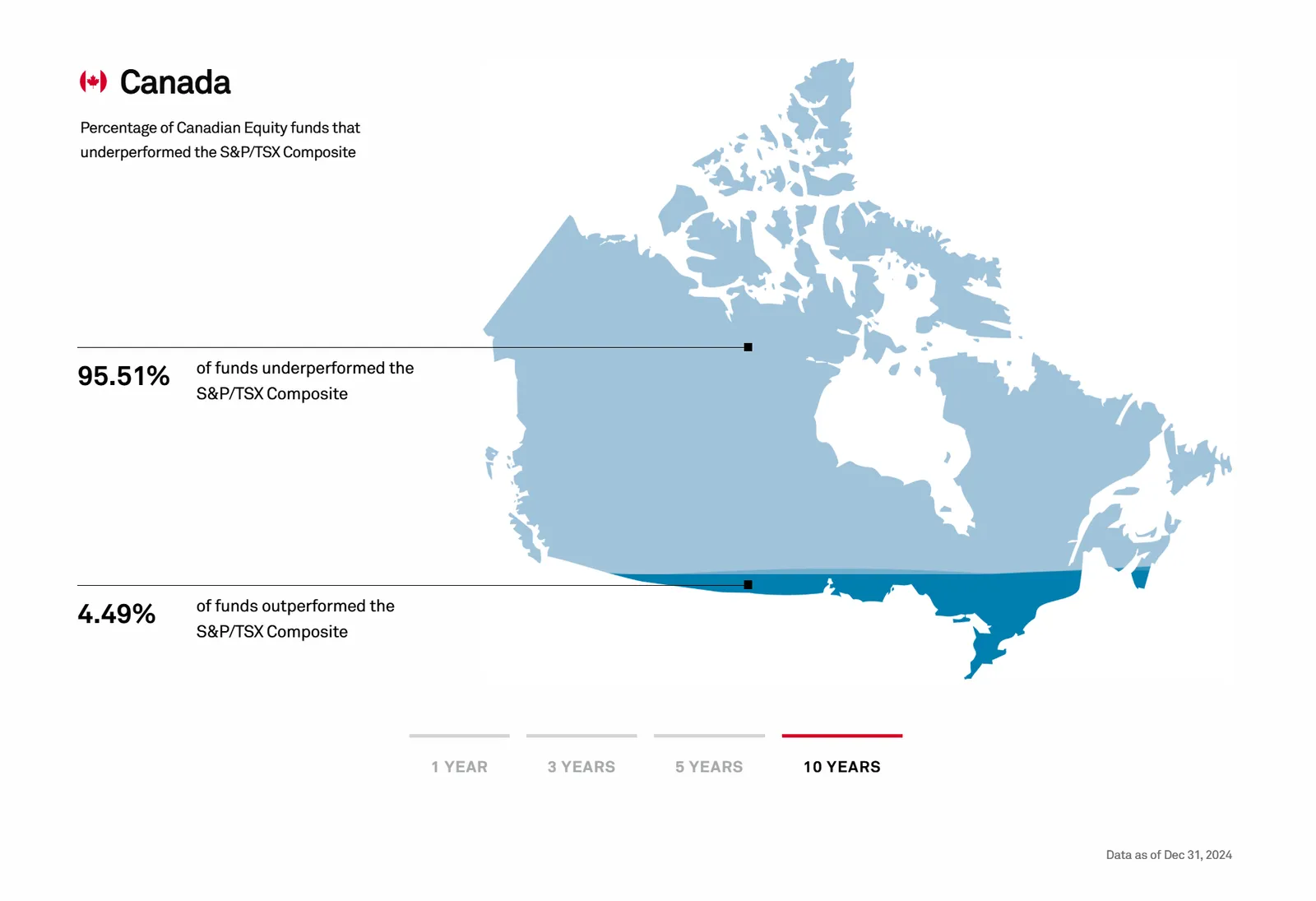
Ok, Jim, given all that, exactly how good are you? Well, in my industry it’s hard to be absolute and definitive, but surely a good place to start is the performance of other managers, and our friends at S&P Global have been kind enough to do exactly that!
The Investment Industry's Track Record
Source: SPIVA
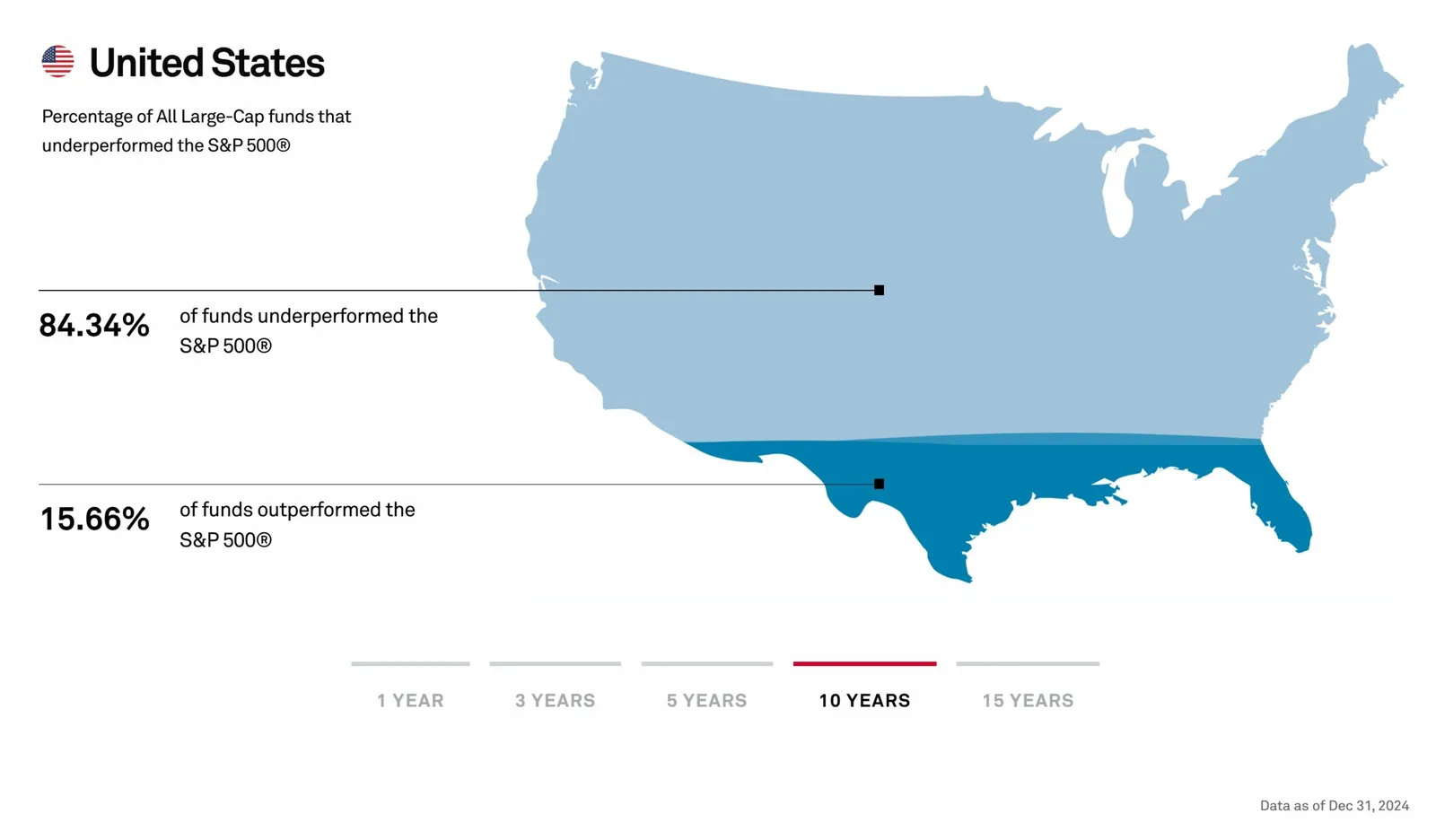
That’s right, 95.51% of Canadian Equity fund managers underperformed the S&P/TSX Composite over 10 years.1 And our southern neighbors have only done slightly less badly:
1SPIVA data is for industry context only and not a direct comparison to WPM’s strategy or results.
Source: SPIVA
The performance of Canadian managers is especially awful, because the S&P TSX/Composite (Canada’s index) consistently underperforms the S&P 500, so they’re failing to clear an already low bar.
Why Our Clients Love Us
With over 25 years of experience in the industry, I believe that Wealth Preservation Management is one of the best Portfolio Managers in North America. What does “one of the best” mean in numbers? We asked our Accountants (DeVisserGray LLP) to recalculate our CAGR (Cumulative Average Growth Rate), and we have achieved a CAGR of 18.15% from June 30, 2017, to December 31, 2025.1
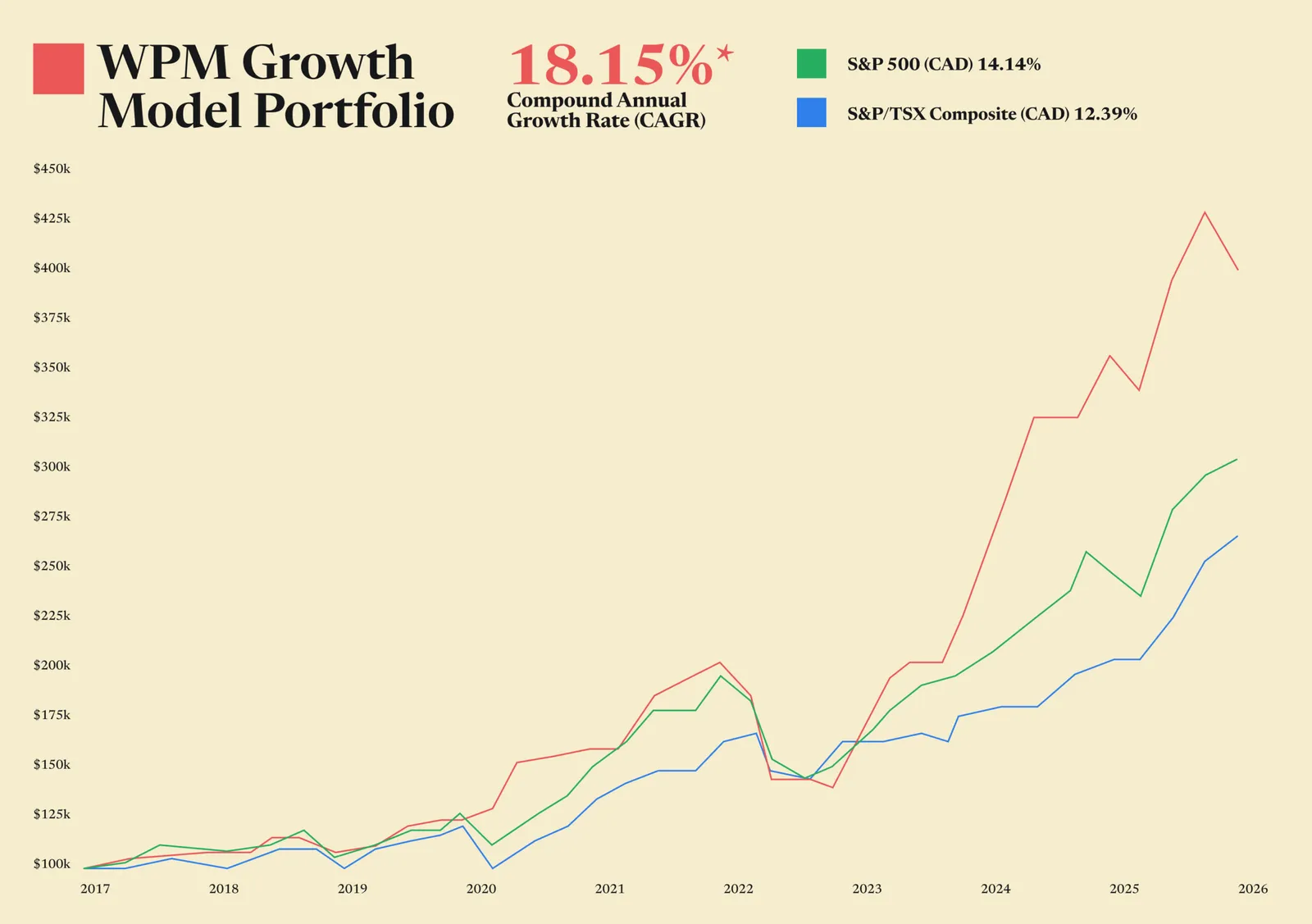
1CAGR independently recalculated by DeVisser Gray LLP. Click here for their report. Return is shown in Canadian dollars, gross of WPM's 2% fee. Past performance doesn't guarantee future results. Investing involves risk, including the possibility of losing money. WPM was registered with the BCSC in March 2023, though the same portfolio manager, James McKnight, has managed the Growth Model Portfolio continuously since inception. Details on benchmark selection here. Details on performance calculations here.
Sweet! I’ll take it. Our clients are thrilled, we earn our fees, and our investment engine is steadily improving.
Is Your Advisor Beating Us?
Now that you know something about me, I’d like to ask you a question:
Are we doing better than your current Investment Advisor?
If the answer is yes (and I suspect it is), then what are you waiting for? Contact us today.