
Slouching Toward Retirement: The High Cost of Low Returns
By Matthew Lloyd (Director of Operations)
Reviewed and approved by James McKnight (Founder & CEO, Registered Portfolio Manager) — “The Prophet of Profit”

“When beggars die there are no comets seen.”
— Shakespeare, Julius Caesar
If You’re Not Building Your Wealth, You’re Burning It
Allow the Prophet of Profit to read your financial tea leaves: you’re too poor.
Sure, you've got the trappings of success—a decent job, not-ugly kids, perhaps even one of those robotic vacuum cleaners that terrorizes dog. Feeling comfortable? Here's a question that'll turn down your comfort thermometer: If your paycheck stopped tomorrow, could you maintain your current lifestyle for the next 40 years?
Squirm at your leisure. Financial epiphanies are never gentle.
Want to Get Rich Faster? Divide by 72
The rule of 72 is a harsh mistress; it’s a method for estimating an investment’s doubling time. Simply divide 72 by your rate of return. At 7%—the kind of return that fills banks and their financial advisors with the pride of puppies in the sun—your money doubles every ~10 years. So what would happen if you achieved a return of 20%?1
1This is a hypothetical return. It is not guaranteed, and investing carries the risk of loss. Based on their objectives, risk tolerance, time horizon and personal circumstances, pursuing a high rate of return may not be suitable for all investors.
Too academic? Let's make it personal.
From Modest to Massive: The Magic of Higher Returns
Imagine you're 40 with $100,000 to invest. Here's your future at 7%:
- Age 50: $200,000
- Age 60: $400,000
Not shameful, but decidedly “meh” when you realize this pittance must last longer than your first mortgage. Your average advisor will call this "meeting your goals." We call it planning for poverty.
Now let's look at your future with 20% returns:
- Age 44: $200,000
- Age 48: $400,000
- Age 52: $800,000
- Age 56: $1.6 million
- Age 60: $3.2 million
A Real Investor’s Journey from $1.2M to $2.5M+ While Spending $80K a Year
If bullet points and six-figure investment accounts don’t set your loins ablaze, let me share a real-world example: One of our retired clients started with $1.2 million (post-house sale), has been drawing $80,000 annually in living expenses for 10+ years, and their account now sits north of $2.5 million.1
1This story is real, but it’s still just one client’s story. Markets go up and down, and every investor’s results will vary.
The best source of security isn’t diversification, asset allocation, or even knowing which way the market will turn—it's simply having more money. We believe that wealth is preferable to poverty.
Most Firms Talk. We Compound.
The Wealth Preservation Management Growth Model Portfolio has returned a CAGR of 18.15% from June 30, 2017, to December 31, 2025.1
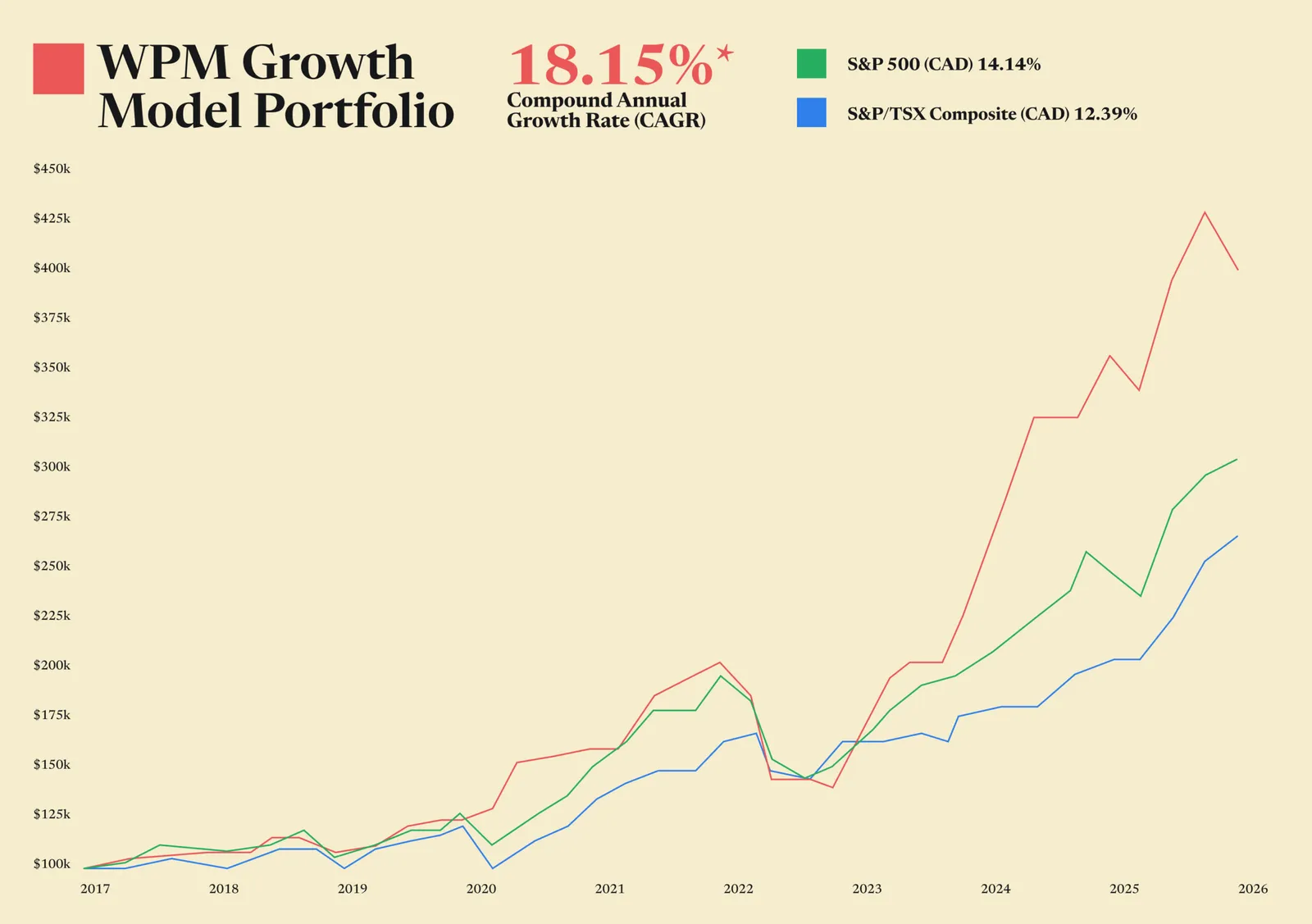
1CAGR independently recalculated by DeVisser Gray LLP. Click here for their report. Return is shown in Canadian dollars, gross of WPM's 2% fee. Past performance doesn't guarantee future results. Investing involves risk, including the possibility of losing money. WPM was registered with the BCSC in March 2023, though the same portfolio manager, James McKnight, has managed the Growth Model Portfolio continuously since inception. Details on benchmark selection here. Details on performance calculations here.
There is no guarantee that WPM can replicate similar returns in the future, however we believe that our best days lie ahead.
You may be too poor today, but you don't have to stay that way. Your investment choices can be the difference between eating cat food or caviar—the choice is yours.
Ka-ching, the check is in the mail.
P.S. If retirement is on your horizon, let's talk. We'll do an in-depth analysis of your portfolio, your retirement cash-flow needs, and create a plan to ensure your “golden” years deserve the name.