Tech Eats the Market: Investing in the Age of Alchemy
By Matthew Lloyd (Director of Operations)
Reviewed and approved by James McKnight (Founder & CEO, Registered Portfolio Manager) — “The Prophet of Profit”

“The future is already here—it’s just not evenly distributed.”
William Gibson
The valiant never taste of death but once.”
—Julius Caesar (Shakespeare)
“We have been and will always be totally unsuccessful in our attempts to repeal the law of supply and demand … we might as well try to repeal the law of gravity.”
—In the Realm of Hungry Ghosts (Gabor Maté)
The Economy Went Digital. Did Your Portfolio Stay Analog?
In 1955, General Motors employed nearly 600,000 people and made about $10 billion—roughly $120 billion in today’s dollars. Today, Apple makes more than forty times that—around $400 billion—with less than a third as many workers. And those iPhones would be beautiful paperweights without the code that turns glass and metal into a global phenomenon.
What used to be an economy of atoms has become one of bits—brawn built the last century; brains will build the next.
For investors, that shift invites a new investment strategy—one that looks beyond what companies make to how they think.
Bits, Not Barrels: The New Wealth of Nations
In the twentieth century, investing often meant choosing between companies that crafted tangible products: cars, planes, cereal, oil. Products obeyed the old arithmetic of industry: more output ergo more input—steel by the ton, workers by the thousand, capital by the bucketful.
The pattern recurred across industries: scale came dear, rivals multiplied, and the ineluctable demands of matter and manpower squeezed every margin. When the economy slowed, vast factories and workforces stood still—monuments to momentum lost.
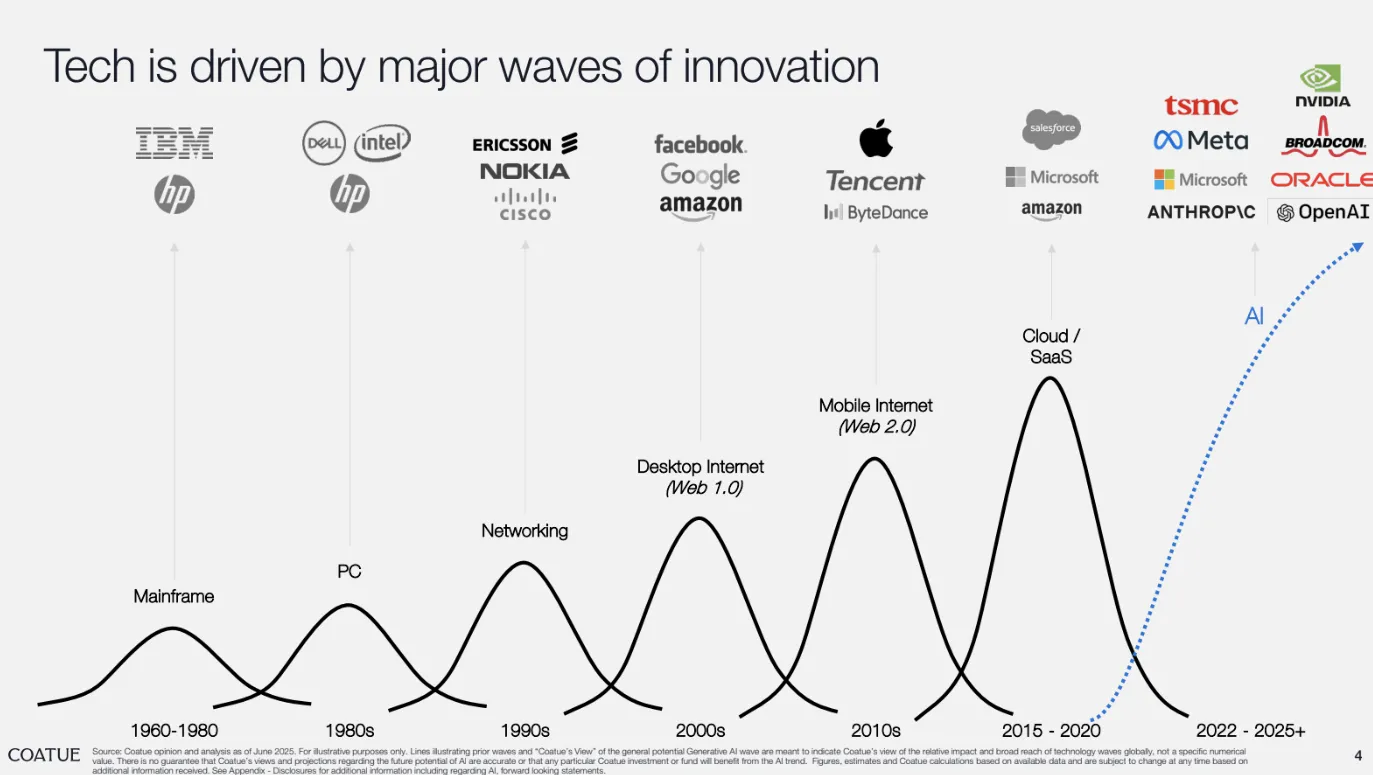
Then came the digital economy. Factories bowed to data centres, conveyor belts to code. Even when something physical is made, the real value is increasingly forged in the cloud. The hum of machinery has faded into the quiet pulse of algorithms.
Source: Coatue
The rise of the digital firm
The new titans of industry deal in the intangible—their empires are measured in data, not tonnage. Their raw material is human ingenuity, their shipping lanes woven from fibre and light.
To call them “technology companies” is too small a frame. They’re idea engines, gathering speed as the weight of the physical world falls away.
The Alchemy of Scale
Distributing ones and zeros over the internet has done something remarkable: it’s loosened the once-iron link between growth and cost. This new alchemy of scale means that once a product is written in code, selling the millionth copy costs almost nothing.
And because these products are digital, expansion is not bound by borders. An entrepreneur in Vancouver can reach a client in Vienna faster than blather moves through a boardroom. Factories needed railways and ports; software needs only Wi-Fi.For investors—and for those of us in portfolio management—this shift requires a rethink. The verities of the industrial age hold less sway over growth in the digital one. Scale now favors imagination over machinery, and portfolios built for yesterday’s economy will struggle to keep up with tomorrow’s arithmetic.
Momentum Machines: Inside the Flywheel Economy
The most powerful digital businesses don’t just sell products—they build platforms. Each new user adds value for all the others, creating a flywheel that spins faster with scale.
In the old economy, selling one more unit rarely changed the value of the next. One more F-150 was just another truck on the lot. So what?
But for digital titans, scale has a beauty all its own. Every user makes Meta more engaging and its ads more potent. Google hones its search with every query. This flywheel produces winner-take-most markets—easy for Eurocrats to lament, but devilishly hard to unwind.
We’ve written before about how this dynamic fuels the rise of corporate titans—why size now feeds on itself in ways the industrial age could only dream of—in Feeding the Beast: Why Corporate Giants Keep Growing.
Revelation in the Ratios: Keeping Score in the Digital Age
The transformation is everywhere once you know where to look.
Companies need fewer employees to generate $1 million in revenue:1
Source: Bradley Saacks/Semafor
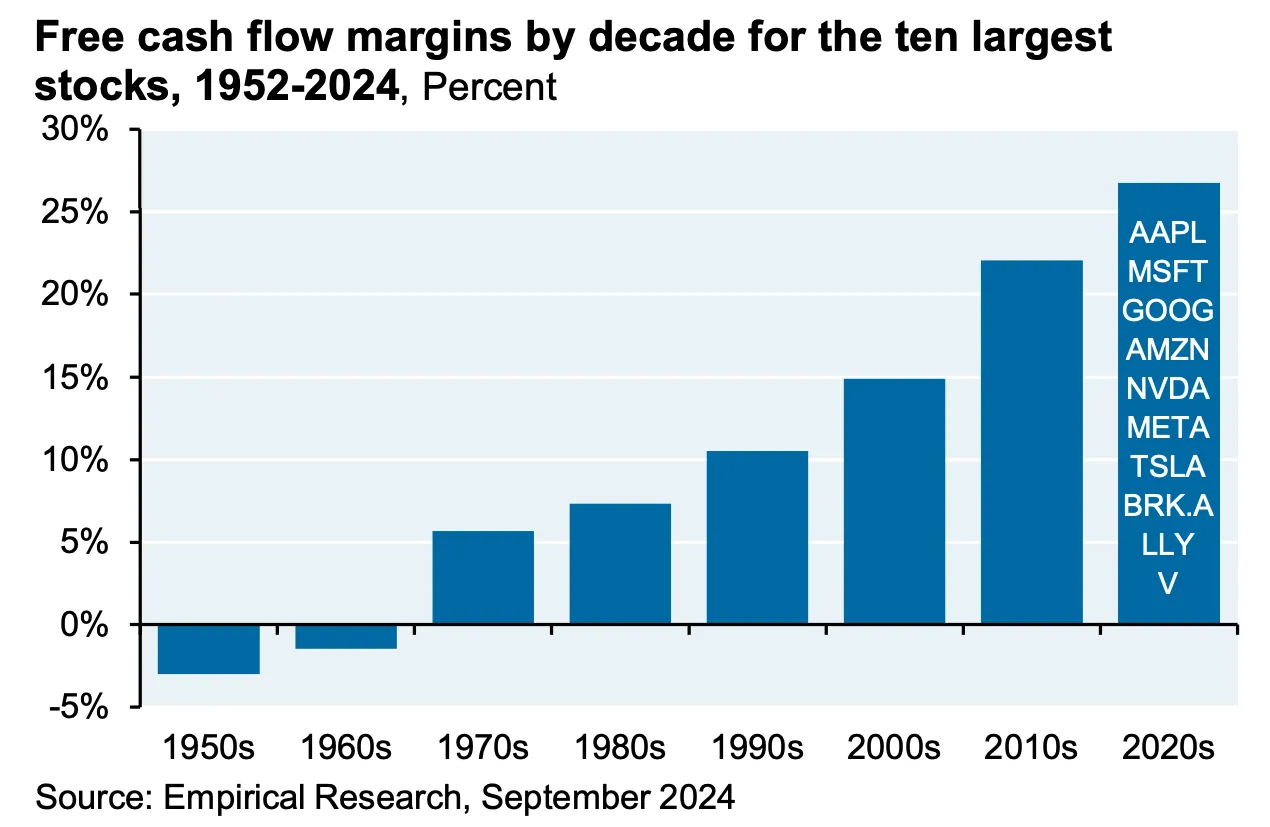
Free cash flow margins—what’s left after the bills are paid—have swollen to historic highs:2
Source: Empirical Research Partners
And the tech sector’s earnings per share (EPS) have surged far ahead of the rest of the market:3
Source: Goldman Sachs
From where we sit, these aren’t accidents of fortune but the ledger lines of a new age—one that has exchanged steel and sweat for code and creativity, the triumph of ideas over inventory.
1The goal of all figures presented is to show the arc, not the arithmetic—the broad direction, not the decimal points. Not adjusted for inflation or changes in industry composition over time.
2Account standards have changed and historical data may not be fully comparable.
3This graphic illustrates how technology-sector earnings have diverged from the broader market in recent years. While results may vary across indexes, the general trend of comparatively stronger tech earnings remains consistent. Index composition and currency effects may affect comparability over time.
The Gods of the New Economy
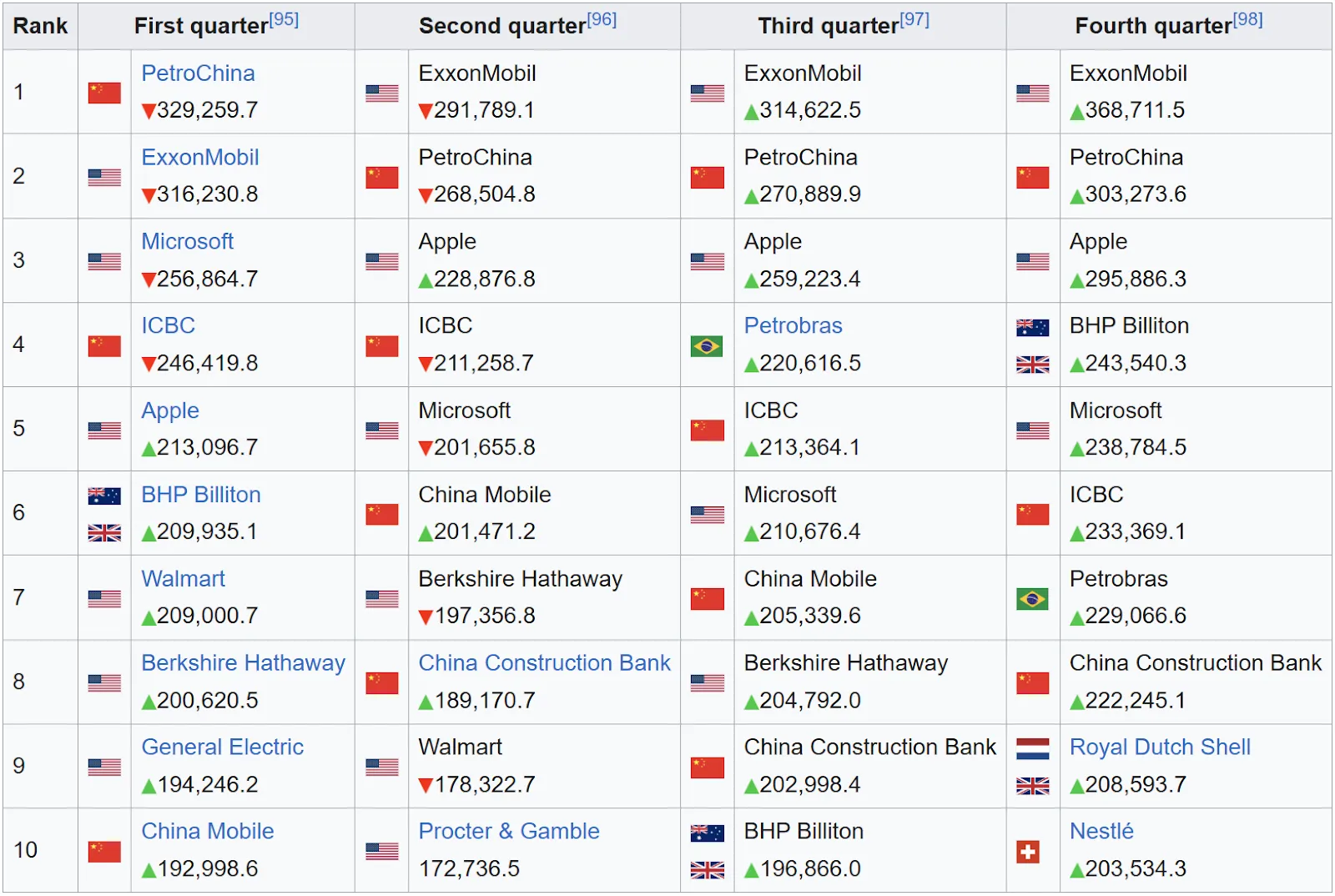
In 2010, the world’s largest firms were masters of the material world: Exxon, PetroChina, GE, Shell.
Source: Wikipedia
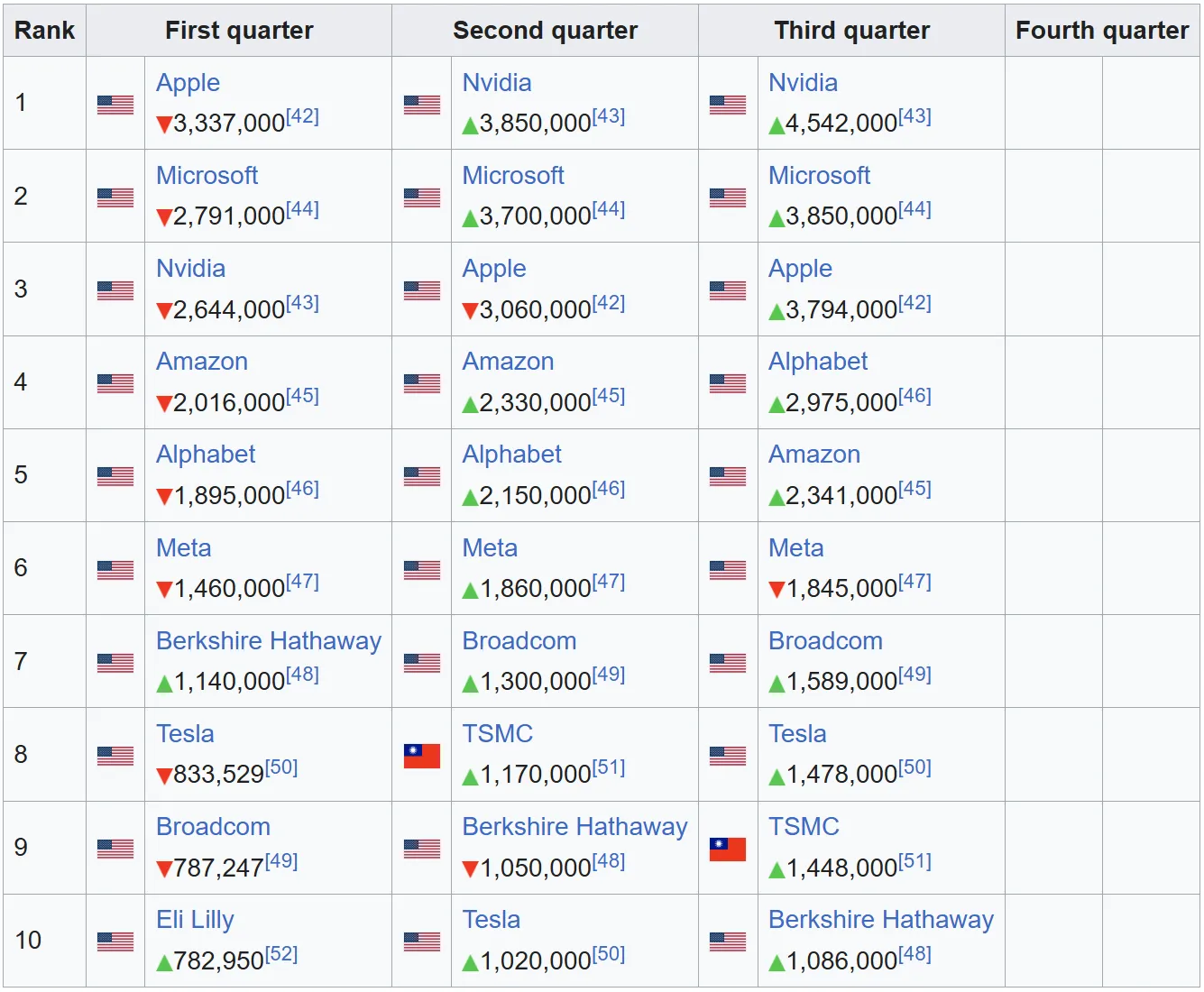
By mid-2025, only Berkshire Hathaway remains on the list: a monument among tech titans.
Source: Wikipedia
The corporate pantheon has new gods—Nvidia, Microsoft, Apple. Steel and oil have lost their divinity. Investors still pray for growth, but they worship at silicon altars.
AI and the Mind’s Capital: Investing in Intelligence
Every great technology is mocked before it’s mastered. AI will be no different. Adoption will stumble, expectations will outpace execution. But we see historic opportunities—electricity powered the industrial age; the internet connected the digital one; and AI will unleash an age of intelligence.
Before we continue, let’s be clear: we’re investors, not disciples. We’ve seen enough hype cycles to know that every miracle technology comes with its own line of believers and bag-holders. That’s why we treat market trends with skepticism first, analysis second, and enthusiasm last. So what makes AI different?
Ubiquity: Intelligence Everywhere
AI isn’t a niche invention—it’s a general-purpose technology. Most innovations reshape one industry; AI reshapes how we think across them all. The internet connected information; AI interprets it. That’s the leap—it applies intelligence, not just access. Like electricity, it plugs into everything—manufacturing, medicine, media—and makes each of them more productive.
Economics: The Collapse of Cognitive Costs
Every past revolution—industrial, digital—reduced the cost of something: muscle, information. AI collapses the cost of cognition. Tasks that once overwhelmed phalanxes of analysts, designers, or decision-makers can now be handled—or hastened—by tireless models.
Velocity: No Roads Required
However miraculous a technology, it can’t reshape the world if it can’t be reached. Electricity waited for grids, cars for roads, the internet for cables. AI needs no waiting—the means to unlock it are already in our hands, on our desks, and across the cloud.
Self-Accelerating: The Tool That Improves Itself
Unlike anything before it, AI is both the product and the means of its own improvement. It makes research faster, design smarter, and iteration cheaper—a tool that helps invent better tools.
In our view, AI will deepen the divide between firms creating the future and those curating the past. The distance between the digital and the dated grows by the hour.
Beyond “Tech”: Diversifying in the Digital Economy
We’re not talking about piling into a basket of look-alike semiconductor stocks. At WPM, our focus is broader—and sharper. Our investment strategy isn’t about chasing every company suddenly “doing AI.” Instead, we look across industries for businesses that use technology to see more clearly, move more quickly, and outthink their rivals. “Tech” isn’t a category anymore—it’s the operating system of the best and brightest in every sector.
As William Gibson said, “The future is already here—it’s just not evenly distributed.” AI looks likely to keep it that way. The spoils will flow to the companies already fluent in code, data, and scale.
Source: Bloomberg (as of Aug 28, 2025)
The New Gravity of Wealth
“This time is different” are the four most dangerous words in investing. They remain so. Markets will swing, valuations will compress, regulators will circle.
But at a structural level, something is different. The sources of profit have migrated. Scale now comes from networks, not factories. Margins flow from data, not drilling. The industrial economy rewarded those who controlled resources; the digital one rewards those who control attention and algorithms.
Post-Industrial Portfolios: Owning the Engines of Tomorrow
The gravity of wealth has shifted—from assets you can touch to platforms you can’t. Not every company draped in “tech” deserves its valuation, but the best will reimagine entire industries: Netflix in entertainment, Shopify in commerce, Axon in public safety. Technology isn’t a sector—it’s a force multiplier.
At Wealth Preservation Management, we invest in builders, not bystanders—and we’ve never seen greater opportunity for Canadians ready to own the engines of tomorrow.
Calling All Investors—The Future is On Line 1
Curious how this future fits into your financial plan? Whether you live in Vancouver, or beyond, let’s talk.